Prof. Jiang
Independent Analysis
Launch promo ends in 00:00:00
Get the Book — $47 $27
Prof. Jiang ——— Geopolitical forecasting · Macro-strategy

The question is never what they said. It is what it cost them to say it.

Fourteen months of escalation, read the way I actually read it — the full reasoning, the named beneficiaries, the errors I made in public. This is the version of my analysis that the videos could not carry.

Instant download · Yours forever
14Chapters
134Pages
5Parts
Prof. Jiang at the whiteboard

“This book is the unhedged version.”

Before You Begin, p. 7
I · The Book

An analysis book, not an opinion book.

That distinction matters more than it sounds, so let me spend a paragraph on it before you spend money.

An opinion book tells you who the good guys are. It arrives at a conclusion you already hold, dresses it in evidence, and sends you away feeling smarter without being smarter. There are a great many of these about Iran. Most of them were written before February.

This one does something narrower and harder. It tells you what actually happened, who actually moved, what that movement revealed about what they can and cannot afford — and how you might have worked it out yourself two weeks earlier.

It does not tell you who deserves to win. It tells you who is bluffing, which is a different question, and the only one I know how to answer.

Why a book, when the videos are free

A video that names which government benefits from a particular escalation, in plain words, with the reasoning attached, does not get taken down. It gets shown to fewer people. It loses its advertisers. So you learn, the way everyone in this business learns, to say it at an angle. To imply. To end on a question mark instead of a sentence.

That habit is not censorship. It is worse than censorship in one specific way: censorship is visible and this is not. You cannot see the hedge. You only see a video that was slightly less useful than it could have been, and no way to know what the unhedged version would have said.

Every chapter here contains a section called What the Video Could Not Say, and that section is the reason the book exists. If you skip everything else, read those.

It is not a leak. I hold no clearance and no source inside any government. Everything here is built from public reporting, government documents, market data and the public statements of the people involved — all of it listed at the back.


II · The Difference

Most people read the statements. This teaches you to read the spending.

How the news trains you to read a crisis

  • Track what leaders say, and treat the loudest threat as the most dangerous one
  • Wait for an analyst on television to tell you what a strike meant
  • Assume an attack on a base means war is coming
  • Take a declared victory at face value, from every side at once
  • Learn a story you cannot reuse the next time something breaks
  • Never find out where the commentator was wrong last year

How this book teaches you to read one

  • Count what was actually spent: munitions, money, lives, credibility — the four currencies
  • Run the blink test yourself, in the first hour, before the analysis arrives
  • Read a casualty-free strike on a headquarters as a signal, not an opening move
  • Price a declared victory against what it cost the party declaring it
  • Keep a method that works on the next crisis, and the one after that
  • Get a chapter — Where I Was Wrong — that names my own errors by date
Get the Book — $47 $27
Instant download · Yours forever
III · What's Inside

Fourteen chapters, five parts, 134 pages.

Read it in order the first time — Parts One through Three build a method, and the later chapters lean on it. After that, treat it as a reference. When something happens in the Gulf, and something will, the index of signals in Chapter Fourteen is where to start.

Part OneThe Method
01
The Blink Test

June 2025: Iran hits the largest American base in the Middle East and kills nobody. Why that sequence ended a war instead of starting one — and the four currencies that tell you who is bluffing.

02
Telegraphed: The Grammar of a Signal

Advance notice, empty buildings, a strike announced before it lands. How states talk to each other in ordnance, and how to read the sentence.

03
Deterrence Is a Reputation, Not a Weapon

Capability, will, restraint. Drop any one and the whole structure fails — and the third is the one that breaks while nobody is watching it.

Part TwoThe Chokepoint
04
Twenty Percent: What a Chokepoint Actually Is

Why a strait is a flow and a strategic reserve is a stock — and why that one distinction explains most of what went wrong in the forecasting.

05
The Toll Booth: Rent on a Waterway You Do Not Own

Closure was never the plan. The payments tell you the strategy, and the instruments used to make them tell you more.

06
The Back Door: What Oman Is Actually For

Inbound through one set of waters, outbound through another. The quiet routing arrangement that keeps the whole system solvent.

Part ThreeThe Alliance
07
Target, Not Ally

Seventy years of a simple arrangement in the Gulf, and the plain version of what the American security umbrella now buys — stated without the hedge.

08
The Bill for Protection: What Riyadh Worked Out

Why a state that can end your national transformation project by itself gets a different kind of non-aggression understanding.

09
Three Wars: Reading the Gulf Separately

Treating the region as one conflict is the most common analytical error of the last fourteen months. Here are the three, pulled apart.

Part FourThe Home Front
10
Fifty to Forty-Eight: How Iran Split a Governing Party

A foreign policy that arrives as a domestic vote count — and what a two-seat margin does to the will half of deterrence.

11
The Price at the Pump Is a Foreign Policy

Four hundred million barrels sounds like a lot until you divide by a flow. Why the pump price is a constraint on escalation, not a consequence of it.

Part FiveWhat Comes Next
12
An Honest Scorecard

Every party declared victory. Here is what each one actually spent, what it got, and what the Gulf lost — plus the one thing it gained.

13
The Successor Problem

February 2026 and after. A leader with unquestioned legitimacy can make concessions; the chapter is about what happens when nobody has that.

14
Fourteen Signals, in Order of Importance

Designed to be opened in the first hour of a crisis, before the analysis arrives. The first four signals are worth more than the remaining ten combined.

Back matter — the reference half

The Fourteen-Month TimelineEvery dated event, compiled from public reporting, with contested figures flagged as contested.
The Reader's ToolkitThe whole method on two pages. Photograph it, or tear it out.
Where I Was WrongMy published errors, by name and by date — including the strait call I repeated for two months.
A Note on SourcesEvery source listed, plus a caution about sourcing on Iranian internal politics.
Get the Book — $47 $27
Instant download · Yours forever
The shape of every chapter

Same five moves, fourteen times.

Every chapter follows the same shape, and the shape is the point.

The OpeningOne specific moment — a date, a decision, a headline that sounded like one thing and was another.
The RecordWhat verifiably happened, with sources, so you and I argue from the same facts.
What the Video Could Not SayThe interests and the beneficiaries, named directly.
The Honest WordThe strongest case against my own reading, and what would prove me wrong.
What to Watch NextThe part you use the next time a headline breaks.
IV · Reader Results

What readers have written back

★★★★★

“I have watched the channel for a year and assumed I already had the argument. Chapter One reframed the June strike for me in about ten minutes. The four currencies alone were worth the price.”

— R. Halvorsen, Norway
★★★★★

“I work in marine insurance. The chokepoint chapters are the first thing I have read by a non-specialist that gets the difference between a closure and a toll right. I have sent it to two colleagues.”

— D. Okonkwo, shipping analyst
★★★★★

“The chapter where he lists his own bad calls is why I trust the rest of it. Nobody else on YouTube publishes a page like that. I keep the Toolkit on my desk.”

— M. Feldman, Ohio
Prof. Jiang
V · About

Who is writing this

I make videos about geopolitical forecasting, alternative historical analysis and macro-strategy, with a particular focus on the Middle East, energy chokepoints and the mechanics of escalation.

I work entirely from open sources. No governmental affiliation, no security clearance, no institutional funding. I am not a former official — and any channel that tells you its host is a former official should be treated with the suspicion that claim deserves.

This is my first book. It exists because the format I work in cannot hold an argument longer than about ninety seconds without losing the audience, and some of the arguments worth making are longer than that.

Corrections are welcome and will be incorporated into later editions, with credit. I would particularly like to hear from readers working in shipping, marine insurance and energy logistics, whose practical knowledge of how the strait actually operates is better than mine.

JiangAugust 2026
VI · Order

The unhedged version, in full.

First Edition · 2026

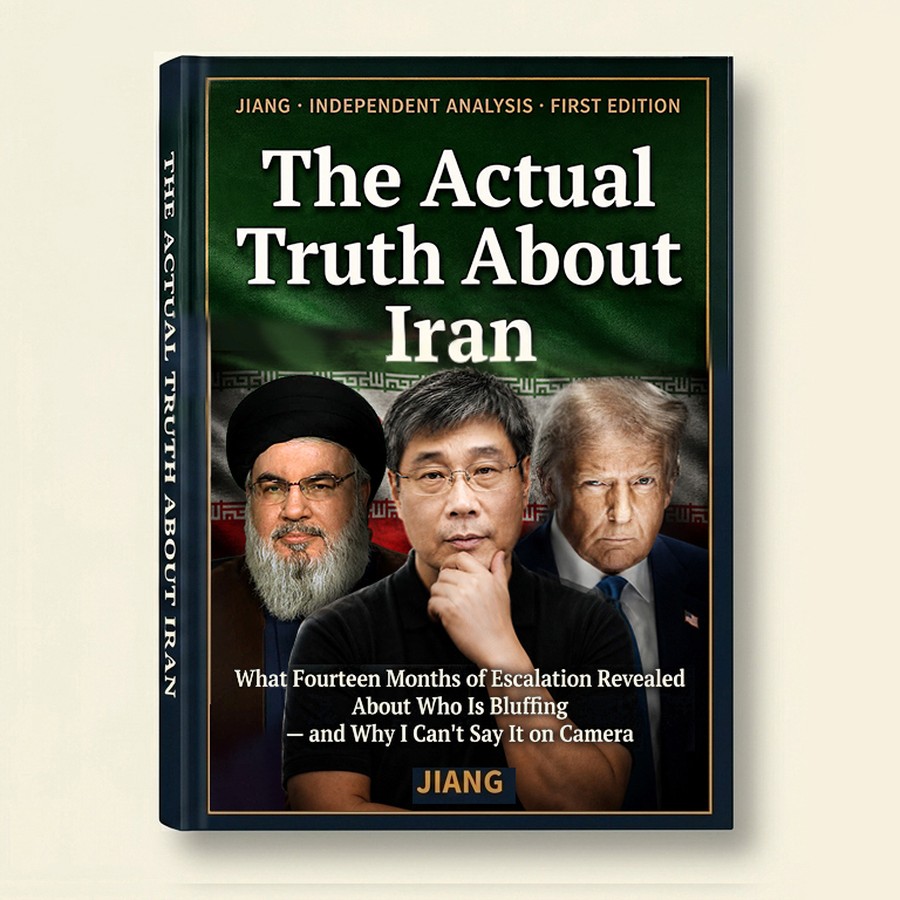
The Actual Truth About Iran

What Fourteen Months of Escalation Revealed About Who Is Bluffing — and Why I Can't Say It on Camera

The Actual Truth About Iran — first edition
  • All 14 chapters, across 5 parts — 134 pages, complete first edition
  • “What the Video Could Not Say” in every chapter — the beneficiaries named directly
  • “The Honest Word” in every chapter — the strongest case against my own reading
  • The Fourteen-Month Timeline — every dated event, compiled from public reporting
  • The Reader's Toolkit — the whole method on two pages, built to be photographed
  • Where I Was Wrong — my published errors, by name and by date
  • A Note on Sources — every source listed, nothing from behind a clearance
  • PDF, readable on any device — phone, tablet, laptop, or printed
$47$27
Get the Book — $47 $27
Instant download · Yours forever
Visa · Mastercard · Amex · PayPal · Apple Pay
VII · Questions

Before you buy

Is any of this classified, or leaked?

No. It is assembled entirely from public reporting, government documents, market data and the public statements of the people involved, all of it listed in A Note on Sources at the back. I hold no security clearance and no governmental affiliation. If you want secrets, this is the wrong book. If you want the reasoning, it is the right one.

Your videos are free. Why buy this?

Because the videos are hedged and this is not. On camera I describe an interest without naming the beneficiary, and end on a question mark instead of a sentence — not because anyone censors me, but because the plain version reaches fewer people and loses its advertisers. Every chapter here has a section called What the Video Could Not Say. That section is the reason the book exists.

Why only $27?

Because the point of writing it was to have the argument reach the people who were already asking the question in the comments, not to price it like a research subscription. $27 is the launch price for the first edition; $47 is where it sits afterward. The work was already done for the channel — the book is the version of it I could not put on camera.

Will this be out of date in six months?

Parts One through Three are a method, and a method does not expire — the four currencies, the blink test and the three conditions for deterrence work on whatever breaks next. The dated chapters are a record of fourteen specific months, and they are written to be read that way. Chapter Fourteen exists precisely so you can run the reading yourself on an event I have never seen.

Do I need a background in this to follow it?

No. Every chapter opens on one concrete moment and lays out The Record before any analysis, so we argue from the same facts. Most of the signals in Chapter Fourteen can be checked in a few minutes by anyone with an internet connection — that is the point of them.

What format is it, and how do I get it?

A PDF, 134 pages, delivered by instant download the moment the payment clears. It opens on a phone, a tablet, a laptop, or a printer. There is no app, no subscription and no waiting for shipping. Yours forever, including on any device you own later.

Do you take corrections?

Yes, and they go into later editions with credit. An analyst who never publishes his errors is not an analyst, he is a brand — which is why Where I Was Wrong is a chapter and not a footnote.

Prof. Jiang
Wait — one thing

Less than one week of coffee.

The unhedged version of fourteen months of analysis — 134 pages, 14 chapters, and the beneficiaries named in plain words. $27 today instead of $47.

Get the Book — $47 $27 or see what's inside →
Instant download · Yours forever